
Zihao Zhang, Norihiro Oshime, Yosuke Hamasaki, Minoru Osada, Shu Morita, Yutaka Takaguchi, Masahiro Yamagami, Tomoko Okubo, Kazumasa Horigane, Naoshi Ikeda, Tatsuo Fujii, Pascale Gemeiner, Pierre-Eymeric Janolin, Satoshi Hirose, Jun Kano*
Abstract
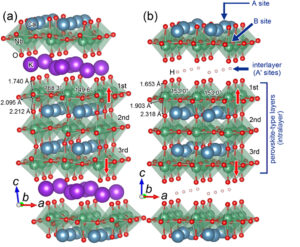
Ion exchange and exfoliation are widely used chemical processes for layered perovskites; however, their impact on vacuum-level-referenced electronic band alignment remains unclear. In this study, we investigate the crystal and electronic band structures of the Dion–Jacobson-type layered perovskite KCa2Nb3O10, its protonated form HCa2Nb3O10, and exfoliated Ca2Nb3O10 nanosheets. Synchrotron x-ray powder diffraction reveals that KCa2Nb3O10 crystallizes in the monoclinic space group P21/m, whereas HCa2Nb3O10 adopts a tetragonal structure with space group P42212, indicating enhanced structural symmetry upon protonation. Energy diagrams referenced to the vacuum level are experimentally determined for all three compounds, enabling direct comparison of valence-band positions and in-gap states induced by ion exchange and exfoliation. In HCa2Nb3O10, a hydrogen-bonded network is found to play a key role in controlling the formation and energy level of in-gap states. These results demonstrate that chemical processing provides an effective route for vacuum-level-referenced band tuning in layered perovskites, offering a practical guideline for band engineering in photocatalytic and related functional oxide materials.