
Kentaro Ito, Eisuke Yamamoto*, Kohei Hayashi, Daiki Kurimoto, Makoto Kobayashi, Minoru Osada*
Abstract
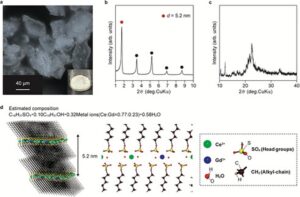
Precise compositional control of 2D nanosheets is critical for advancing the rational design of 2D functional materials. Solid-state surfactant templating has recently emerged as a powerful strategy for synthesizing non-layered 2D oxide nanosheets; however, its broader applicability has been constrained by the lack of rational design principles for multicomponent precursors. Here, we establish a general framework for precursor surfactant design that enables programmable compositional control in non-layered 2D oxide nanosheets. Using cerium oxide doped with a range of rare-earth elements (La, Pr, Sm, Gd, Yb, Y, and Sc) as a model system, we show that precursor crystal compositions are determined not only by nominal stoichiometry but also by selective incorporation governed by ionic radii. In contrast, the resulting nanosheet compositions deviate systematically due to differences in dopant reactivity during condensation, which correlates with the hydrolysis tendency of the metal cations. By rationally balancing these competing incorporation and reaction effects, nanosheets with targeted compositions are achieved. This work elevates solid-state surfactant templating from an empirical method to a designable synthetic platform, offering broadly applicable principles for the synthesis of compositionally programmed 2D oxide nanosheets.