
Eisuke Yamamoto*, Renjiro Hara, Yuma Takezaki, Makoto Kobayashi, Ruben Canton-Vitoria, Minoru Osada*
Abstract
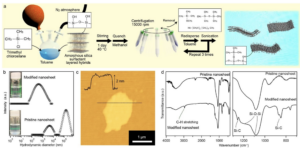
Free-standing amorphous silica nanosheets have recently emerged as a new class of two-dimensional materials. Although surface modification has long been investigated for conventional silica materials, the modification of molecularly thin amorphous silica nanosheets remains largely unexplored. In this study, we investigated the surface functionalization of monolayer amorphous silica nanosheets synthesized using a solid-state surfactant template. The surfactant-silica layered hybrids were directly treated with chlorosilanes prior to exfoliation into monolayer nanosheets. Trimethylsilylation enabled stable colloidal dispersion of the nanosheets in toluene, whereas unmodified nanosheets readily aggregated. The degree of surface modification and colloidal stability strongly depended on the amount of chlorosilane employed. Furthermore, surface modification using dimethylvinylchlorosilane was also achieved, suggesting the applicability of the present strategy to a variety of chlorosilanes. These results demonstrate that molecularly thin free-standing amorphous silica nanosheets can be functionalized while maintaining their monolayer nature, providing a versatile platform for the design of silica-based organic-inorganic hybrid materials.