
Shu Morita, Keita Nishibashi, Keito Niwa, Makoto Kobayashi, Eisuke Yamamoto, Ruben Canton-Vitoria, Daisuke Urushihara, Toru Asaka, Hidetaka Kasai, Shigeo Mori, Minoru Osada*
Abstract
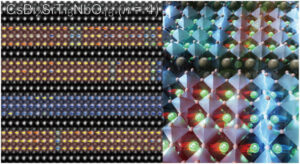
Perovskite ferroelectrics remain central in electronic materials research, with hybrid improper ferroelectricity (HIF) offering a mechanism to realize spontaneous polarization through nonpolar octahedral distortions. A promising approach for expanding the family of HIF materials is to examine layered perovskites with four or more layers (n ≥ 4). Here, we employ Dion–Jacobson-type homologous layered perovskites Cs(Bi2Srn–3)(Tin–1Nb)O3n+1 (n = 3, 4, and 5) as a model system to study their ferroelectric domain structure with atomic-scale analysis. Aberration-corrected scanning transmission electron microscopy reveals the evolution of domain structures from neutral walls (n = 3) to coexisting neutral and charged walls (n = 4 and 5). In the HIF compound CsBi2SrTi3NbO13 (n = 4), the suppression of both elastic and dipolar energy components results in lower overall domain wall energy, thereby promoting the formation of unit-cell-thick, nanosized domains. Our study addresses the complex structural and energetic landscape of high-order perovskites, opening pathways for understanding and designing advanced ferroelectrics based on HIF.